
BALINESE OM SYMBOL is deeply sacred and considered to be the form of the supreme god. It is one of the graphic embodiments of the divine, which is made with Bali language but evolved from the Devanagari script of Sanskrit. It is used to denote the spirituality and truth behind the creation and then its return to the formless. Every symbol or curve in the om has meaning.
There are three sounds in om: A-U-M, which is chanted indifferently to make a connection with the self. Bali Symbols and meanings are always unique. For the same curiosity and to discover the whole truth behind the great sign, we are moving into deeper parts. It is also known as “Ida sang Hyang Widhi Wasa,” which means the Supreme Lord.
What are the origins and blissful meanings of the Balinese Om symbol and sound?
Om is the "higher sound of the world. In yoga, "Om” is chanted at the beginning of the yoga practice as well as at the end and “Om Shanti Om” means peace, peace, peace. It is used as a symbol and as a sound in prayers and ritual chants, during sacred acts, yoga and tantra. Here, you can view the Om symbol in more scripts, namely the Balinese Om.The Balinese Om symbol represents the supreme deity, Sang Hyang Widhi Wasa, in Balinese Hinduism.
As in the Hindu religion it is believed to be in the form of the askshara (word) and the sound of Brahman, the highest Universal principle and ultimate reality of the universe. It has several stories as to its possible origin. The Balinese om symbol represents the supreme God in Balinese spirituality.
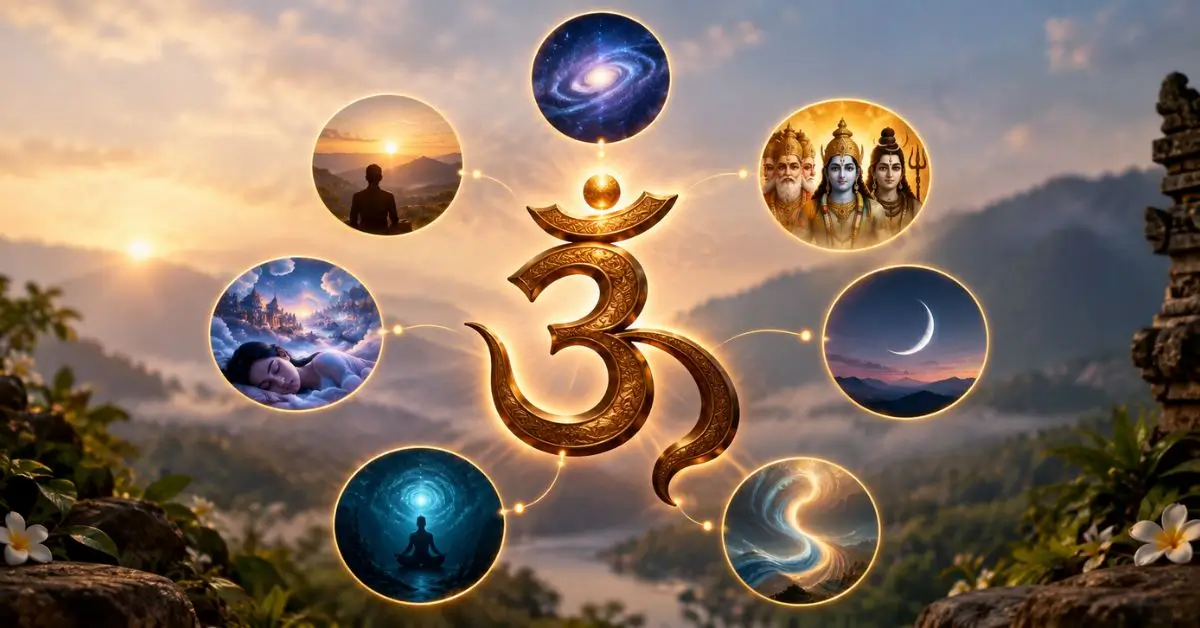
It is a representation of the sound and also represents the reason behind the creation of god. How this world is sustained and how it goes against formless ways, it denotes everything. Three phonemes in the AUM sound represent: Brahma, Vishnu & Shiva (The Great Trideva). This is an artistic and philosophical symbol that evolved originally from the Sanskrit OM. It also looks like the Lord Ganesha symbol. The structural explanation of Ongkara is different:
- Upper loop- It denotes the waking state of the body and mind, which is also known as “Jagrata Awastha”.
- Bindu or dot- It is denoted as pure consciousness of the universe. When there is nothing, it is pure consciousness, which manifests itself in different forms.
- Main Body- Mainly known as the dream state or “Svapna Awastha,” we can also say that this world is denoted in the form of the dream state. Every being is in a dream state, and the material world is part of this.
- Ardchandra- It is also spelled as “Ardhcandra,” which is a crescent shape with a slightly lower side. It is a transcendent state of consciousness that manifests itself in different states.
- Nada- It is denoted by the flowing tail at the end part of it, and it is a symbolic form of the mind, which has desires and determination to complete them.
- Lower curve- Deep sleep or “Sushupti Awastha” is shown in the form of a lower curve. It is also mentioned that it denotes lower “lokas”.
The complete explanation of the BALINESE OM SYMBOL denotes the vast universe and its manifestation. It explains the story behind the cosmic powers. There is a mention of the Balinese Om Symbol in “Chandogya Upanishad," which mentions it as the divine uttering sound.
What Does Om Symbol Mean?
Three sounds in Om are A-U-M, each has a story behind that, and when we chant them, the sound and vibration of each word is unique, coming out of different body parts. Ancient texts in Agma Hindu Dharma also mention them as explanations of the initiation of the universe, its diversity, and extinction. Here is the complete explanation of the Om sound.
- A (Akara)- This is the opening sound in Om chanting, and this sound came from the navel region. Generally, 50 % of breath is exhaled while we chant Aaaa in long form. This denotes “Brahma,” who is the creator of the universe.
- U (Ukara)- It represents Vishnu, who is the god of sustaining force in the world or the balance of the world. Lord Vishnu is balancing the whole world with the manifestation force.
- M (Makara)- The word “M” represents the transforming force of the universe, which is “Shiva,” the destroyer or transformer. Lord Shiva is known for their formless transformation from “akara to Nirakar”.
Also May You Like:- 100 Hour Yoga Teacher Training Course in Bali
What is the Significance of Om in Hinduism?
There are many explanations in Vedanta about the Om sound; it also depends on the version. It is also believed that many religions have the Om Symbol in different symbolic forms. This is the sound of the universe, which creates and maintains the life forces. In Hinduism, every Mantra starts with the initial sound of “aum”. Even in the four Vedas, there is mention of the waking, dreaming, and deep sleep states of the body, which are symbolically defined in the form of “OM”. Here are some significance of “OM” chanting in Hinduism:
- It is the primordial sound of the universe.
- It shows the entire universe and its symbolic form, like: Three Gunas (earth, atmosphere, heaven), three Vedas, and three qualities of nature.
- It is the formless reality of the universe and culminates in truth,
- This sound has manifested itself at different levels of life.
- It appears in the oldest Hindu scriptures (Upanishads, Bhagavad Gita, Vedas).
- Om chanting is also done for peace, stress relief, and balance.
- It brings peace, focus, and spiritual liberation (moksha).
In the Bhagavad Gita, Lord Krishna declares: "I am the purifier, the goal of knowledge, the sacred syllable Om. So these are some importance which is mentioned about the Om chanting and its symbolic form in the Vedas. According to Hindu belief, OM provides eternal bliss, peace of mind, and helps one gain ultimate knowledge.
Also Go Through:- 200-Hour Yoga Teacher Training in Bali
All About Ongkara Symbol: Waktu Sholat Isya Di Bali
The Ongkara symbol is a sacred symbol of Hinduism to the universe as "Om," the sound of the universe and therefore the universe's creation. This symbol is widely used in the Balinese religion and culture; it can be found on temples and in homes, and is used in artwork to document and remind us of our spiritual balance.
The time of day for the Isha prayer in Bali is determined by the position of the sun; it generally occurs approximately 1.5-2 hours after sunset each night. Regardless of religious beliefs, the people of Bali have a harmonious way of life with one another due to their mutual respect. As a result, the multitude of Hindu traditions and Islamic practices in Bali are seen as examples of tolerance and social unity existing side by side.
Final Thoughts
“AUM” or OM sound is the initiation sound of the universe; it explains the structure and balance of the universe. The Balinese Om symbol is a symbolic representation of the great Trideva in Vedanta, and each sound represents one of them. Every mantra chanting mentioned in the Vedas started with the sound of Om.
Om has manifested itself in different forms, which is the dream world according to the Vedanta philosophy. In Bali, Om is mentioned in scriptures, in homes and temples, and is also considered a symbolic representation of Lord Ganesha. It is considered that by chanting Om repeatedly, one simultaneously worships and appeases all three Lords of the Trinity — Brahma, Vishnu, and Shiva — at the same time.
Share Post
No Comments Yet